When it comes to psicologia-clinica-k02, formación complementaria en psicología clínica está disponible a través de Intercontinental, con inscripción y acceso al aula completamente gratuitos. Profesionales de la salud mental en Colombia y Latinoamérica actualizan competencias diagnósticas y terapéuticas mediante cursos virtuales flexibles. El costo de la certificación final es de 80.000 COP (25 USD fuera de Colombia). Se recomienda contactar directamente a la institución para conocer más detalles.
Key Takeaways
- Politécnico Intercontinental ofrece más de 700 cursos virtuales gratuitos en psicología clínica y salud mental.
- La inscripción, acceso al aula y formación son completamente gratuitos; el costo de la certificación es de 80.000 COP (25 USD fuera de Colombia).
- Programas especializados incluyen neurorrehabilitación, terapia asistida, duelo, depresión y habilidades clínicas para profesionales.
- Profesionales de Colombia y Latinoamérica acceden a formación continua flexible con estudio a su propio ritmo.
Why Add Complementary Resources to Your Clinical Training?
Complementary resources close the gap between a single diploma and a complete clinical skill set. Safe, up-to-date practice depends on continuous learning, not a one-time certificate. Mental health professionals who stop studying after graduation risk falling behind on diagnostic tools, intervention models, and ethical standards that shift year after year.
A psychology-clinical training path builds confidence, but confidence alone does not treat patients. Clinicians need layered knowledge: theory, technique, and supervised practice working together. Adding short courses on specific populations, disorders, or therapeutic approaches rounds out that foundation without requiring a second degree.
How does someone tell a solid course from a shallow one?
Not every free resource online offers rigor. Choosing a reliable psychology course means distinguishing popular, entertainment-style content from structured clinical formation. A trustworthy program states its learning objectives clearly, assigns real coursework, and connects each topic back to patient care.
Professionals evaluating options should look for:
- Clear learning objectives tied to clinical competencies
- Structured modules, not isolated videos or articles
- Assessment or practice components, not passive viewing
- A credentialing path, since a psychology certification confirms the hours actually translate into recognized training
Why does flexible, self-paced study matter for working clinicians?
Most psychologists juggle caseloads, supervision hours, and personal obligations. Self-paced virtual classes let them study during gaps in the schedule instead of sacrificing income or client time.
Politécnico Intercontinental supports this pattern through free virtual courses and diplomas designed to help professionals advance across Latin America. Stacking several short, focused programs around a core clinical specialty builds a far more adaptable skill set than relying on one credential alone.
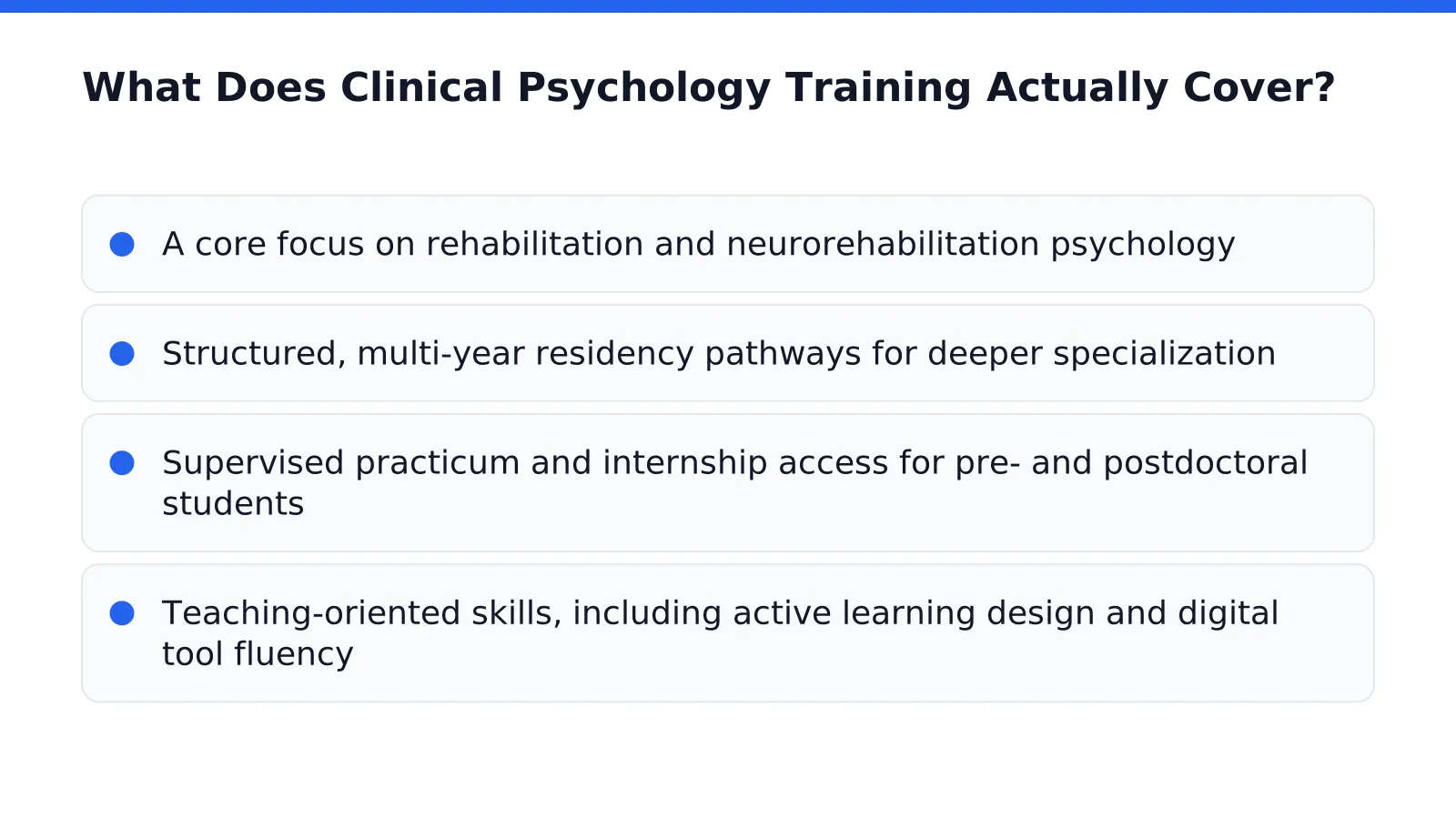
What Does Clinical Psychology Training Actually Cover?
Rehabilitation psychology anchors most structured training programs in clinical psychology today. Programs built around this focus prepare professionals to support patients recovering from neurological injury, chronic illness, or physical trauma that affects mental health alongside the body.
Depth matters more than breadth in this field. Some institutions structure residency-style programs that span two full years, with specialization in neurorehabilitation psychology built into the curriculum. A timeline like that allows trainees to move from foundational theory into supervised clinical practice without rushing.
Who Can Access Supervised Clinical Training?
Postdoctoral psychology students seeking additional supervision toward licensure fit squarely into these programs. Predoctoral graduate students also gain access through structured internships and practicum placements. Both groups work toward the same goal: hands-on experience in neurorehabilitation psychology that satisfies licensing requirements while building real clinical judgment.
Does Training Extend Beyond Clinical Technique?
Yes. Strong training doesn’t stop at diagnosis and treatment protocols. Diploma-style continuing education adds a teaching dimension, covering active learning methods and digital resource use that clinicians apply when educating patients, families, or junior colleagues.
Clinical competence and teaching competence reinforce each other. A practitioner who understands how to design engaging, participatory learning experiences communicates treatment plans more effectively and builds stronger patient trust.
Together, these elements define a complete psychology course experience:
- A core focus on rehabilitation and neurorehabilitation psychology
- Structured, multi-year residency pathways for deeper specialization
- Supervised practicum and internship access for pre- and postdoctoral students
- Teaching-oriented skills, including active learning design and digital tool fluency
Professionals who pursue psychology certification through this kind of layered training leave with more than a credential. They leave equipped to diagnose, treat, and teach with confidence.

What Complementary Resources Does Politécnico Intercontinental Offer?
Politécnico Intercontinental organizes its full catalog inside one dedicated section of certified free courses. Diplomas, making every option easy to browse in one place. Mental health professionals searching for a structured curso-psicologia-k02 find related diplomas grouped together rather than scattered across the site. That organization saves time for clinicians juggling patient schedules.
The institution itself operates as a Colombian training entity recognized as an Institución de Educación para el Trabajo y el Desarrollo Humano. It works in alliance with Politécnico de Suramérica, extending its reach across Colombia and the rest of Latin America. This partnership supports more than 700 virtual courses. Diplomas, giving mental health professionals a wide base of continuing education options beyond a single psicologia-clinica-k02 track.
Are these complementary courses really free?
Enrollment, classroom access, and the training itself cost nothing. Only the final credential, the certificacion-psicologia-k02, carries a fee. The learning process stays open at no charge from registration through course completion.
How do these resources fit a working clinician’s schedule?
Flexibility defines the learning process built into each free course. Professionals progress through modules at a pace that respects clinical hours, supervision duties, or private practice demands.
Beyond individual courses, the broader catalog gives psychology graduates a way to diversify competencies without added cost at the learning stage. Consider how the resources complement one another:
- Centralized access: every free course and diploma lives in one certified-courses section for simple browsing.
- Zero-cost learning: registration, classroom entry, and instruction remain free throughout.
- Flexible pacing: modules adapt to irregular clinical schedules rather than fixed class times.
- Regional reach: the Polisura alliance extends offerings across Colombia and Latin America.
Together, these resources let mental health professionals treat continuing education as an ongoing habit, not a one-time expense.

How Do Complementary Virtual Diploma Programs Work?
Complementary virtual diploma programs combine short, structured modules with a final certification phase. Clinical professionals move through content at their own pace, then demonstrate competency before receiving credentials. The design favors working professionals who cannot commit to rigid class schedules.
Most free virtual diplomas run around 80 certification hours on average, a length that fits a practicing clinician’s calendar without demanding months of full-time study. That window is long enough to build real competency, yet short enough to finish alongside a regular caseload. Business-oriented virtual diplomas follow the same logic: they sharpen a professional profile, open new labor opportunities, and update knowledge within a given sector. That model transfers directly to clinical specialization. A psicología clínica practitioner needs updated tools without stepping away from patient care.
What skills do these programs actually build?
Specialized diplomas, like those built for non-licensed professionals seeking advanced training, show the pattern clinicians can expect from a curso de psicología structured this way. They deliver targeted competency building rather than broad theory. Learners walk away able to evaluate processes using quality, innovation, and relevance criteria, the same evaluative skill set a clinical supervisor applies when assessing intervention outcomes or training programs.
Why does the certification step matter?
Certification confirms that a professional completed the coursework and met the program’s standards. Without it, the training hours carry no formal credential attached to a resume. A certificación de psicología backed by defined hours. Clear competency criteria gives Latin American clinicians documented proof of continuing education, something hiring committees and licensing boards look for specifically.
What Other Free Mental Health Training Options Exist?
Beyond Intercontinental’s own catalog, publicly available information from the Pan American Health Organization (PAHO/WHO) describes self-paced virtual courses built to strengthen mental health capacities across the Americas. According to that organization’s own materials, PAHO designed this training in partnership with its educational platform, the Virtual Public Health Campus. The result gives Latin American mental health professionals another structured way to build skills on their own schedule, without classroom constraints.
Cost presents no barrier here, based on the organization’s published description. Every course runs completely free of charge, and participants move through content at their own pace. According to PAHO’s own materials, the organization issues a certificate of participation once a learner finishes the material, giving professionals documented proof of continuing education.
What topics does this external training cover?
One notable course, as described in PAHO’s published materials, targets emergency responders and frontline personnel. It teaches participants to identify and manage work-related stress, a hazard of first-line response work. The course also provides practical self-care resources, helping responders sustain their own well-being while supporting others in crisis.
How does this training fit into broader professional development?
Professionals building a career in clinical psychology often look beyond a single workshop. They assemble a portfolio of credentials over time, mixing international offerings like PAHO’s with other continuing-education paths, including those from Intercontinental.
For Colombian and Latin American practitioners seeking a complete psychology course pathway, pairing free specialized modules like those referenced above with broader diploma programs builds a more complete skill set. Formal certification in psychology credentials from accredited institutions then round out that professional profile, giving employers verifiable proof of updated clinical competencies.
How Do You Spot Rigorous Free Courses?
Rigor shows up in structure, not in the price tag. A genuinely strong psychology clinical training program proves its worth through the strength of its clinical framework. How directly its content applies to real patient work. Cost-free access means little if the curriculum skips assessment models, ethical standards, or evidence-based intervention techniques.
Well-built course materials do something specific: they connect classroom theory to the realities of clinical consultation. A lecture on attachment theory matters only when it translates into a usable approach for the next session with a patient. That bridge between concept and practice separates a rigorous psychology course from a collection of recorded slides.
What should a quality introductory itinerary include?
A solid introductory pathway organizes core concepts in a logical sequence, rather than presenting them as disconnected topics. It also pushes professionals to examine their own clinical biases and refresh outdated assessment models. Programs that skip this step leave graduates reciting theory without the judgment needed to apply it.
Professionals evaluating options can check for these markers before enrolling:
- A clear progression from foundational theory to applied technique
- Content built around assessment models, not just descriptive overviews
- Opportunities to revisit clinical biases and diagnostic habits
- Direct relevance to patient-facing scenarios, not abstract case studies
Does a free format mean lower academic standards?
Not necessarily. Politécnico Intercontinental positions itself as a leading educational institution in Colombia, built around free virtual courses and diplomas designed for accessibility and professional growth. Proper certification in psychology training proves that structure, not cost, determines rigor. A well-designed free program can match the instructional depth of a paid one, provided the framework and applicability hold up under scrutiny.
How Do You Enroll and Get Certified?
Four simple steps separate a mental health professional from a completed clinical psychology credential. The top navigation menu organizes every training center and learning pathway, making the search for a relevant topic straightforward rather than overwhelming.
Where does the enrollment process begin?
Enrollment begins with choosing the right psychology course and clicking its enrollment button. From there, candidates complete the enrollment form with personal and contact data. This step unlocks access to the virtual classroom, where course materials and instructional content become available.
The sequence looks like this:
- Browse the navigation menu to find a course or diploma matching a professional interest, such as neuropsychology, grief counseling, or clinical skills.
- Click the enrollment button on the chosen program’s page.
- Fill out the registration form with accurate personal data.
- Enter the virtual classroom and begin the coursework at an individual pace.
Does certification cost money even if the course is free?
Yes, certification carries a cost even though the course itself does not. Enrollment, classroom access, and the training content stay completely free for every student. Only the certification step requires payment: 80.000 COP in Colombia (25 USD outside Colombia). Professionals should contact the institution directly for additional details.
This distinction matters for budgeting. A graduate student juggling tight finances can complete an entire diploma, absorb the clinical content, and test new diagnostic frameworks without spending a peso. Payment only becomes necessary when a verifiable, presentable credential is needed for a résumé, job application, or licensing requirement.
Professionals should also note the institution’s compliance standing. Cumplimiento normativo y transparencia institucional: Vigilado y Controlado por la Secretaría de Educación de Itagüí, which confirms that the credential sits within a recognized regulatory framework rather than an informal training label.
Which Complementary Resources Should You Choose Now?
Mental health professionals build
FAQ
¿Cuánto cuesta un curso de psicología clínica con Intercontinental?
La inscripción, el acceso al aula y la formación son gratuitos; solo la certificación final cuesta 80.000 COP, equivalente a 25 USD fuera de Colombia.
¿Cómo distinguir un curso virtual de psicología clínica confiable?
Un programa confiable define objetivos de aprendizaje claros, incluye módulos estructurados con trabajo real, componentes de evaluación y una vía de certificación que respalde las horas de formación.
¿Por qué es útil la modalidad virtual y flexible para psicólogos clínicos en ejercicio?
Permite estudiar a su propio ritmo durante espacios libres de la agenda, sin sacrificar ingresos ni tiempo con pacientes, combinando varios cursos cortos alrededor de una especialidad clínica.